
NCERT Class 9 English Chapter 6 My Childhood
NCERT Class 9 English Chapter 6 My Childhood
NCERT Solutions for Class 9 English Beehive Chapter 6 My Childhood
Textbook Questions
Thinking About The Text
(Page 74)
Activity : Find Dhanuskodi and Rameswaram on the map. What language(s) do you think are spoken there ? What languages do you think the author, his family, his friends and his teachers spoke with one another ?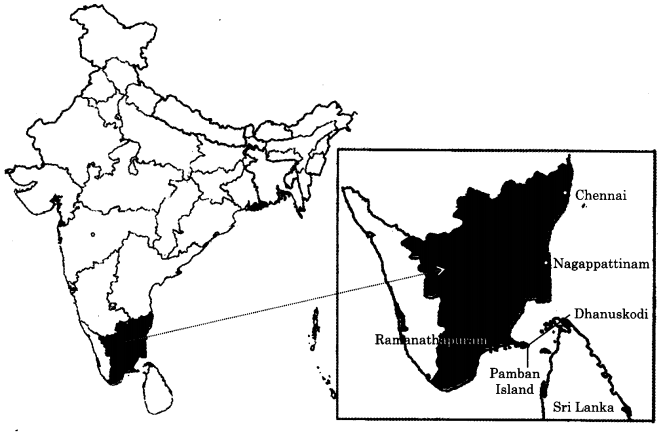
Answer
For self-attempt.
The language Tamil is spoken there.
I. Answer these questions in one or two sentences each.
- Where was Abdul Kalam’s house ?
- What do you think Dinamani is the name of ? Give a reason for your answer.
- Who were Abdul Kalam’s school friends ? What did they later become ?
- How did Abdul Kalam earn his first wages ? (CBSE)
- Had he earned any money before that ? In what way ?
Answers
1. Abdul Kalam’s house was situated in Rameswaram.
2. Dinamani is the name of the newspaper. Abdul Kalam used to trace the headlines of this newspaper for news about the War.
3. They were : Ramanadha Sastry, Aravindan and Sivaprakasan. Ramanadha Sastry became the priest of the Rameswaram temple. Aravindan took up the transport business. Sivaprakasan became a catering contractor for the Southern Railways.
4. He earned his first wages by becoming a helping hand to his cousin. He caught the newspapers bundles for him from the moving train.
5. Yes, by collecting tamarind seeds and selling them to a provision shop.
II. Answer each of these questions in a short paragraph (about 30 words).
- How does the author describe : (i) his father, (ii) his mother, (iii) himself?
- What characteristics does he say he inherited from his parents ?
Answers
1. (i) The author describes his father as a simple man. He had neither much formal education nor wealth. But he had great wisdom. He was very large-hearted. He was very considerate. He was also an austere man.
(ii) The author describes his mother as kind and large-hearted. She used to feed many people everyday. She had all the motherly qualities. The author went to Ramanathapuram for further studies. She became emotional then.
(iii) About himself the author says that he was one of many children. He was a short boy with rather undistinguished looks. Theirs was a middle-class Tamil family in Rameswaram.
2. The author inherited faith in kindness and deep kindness from his mother. He also inherited honesty and self-discipline from his father. His three brothers and sister also inherited these like him.
III. Discuss these questions in class with your teacher and then write down your answers in two or three paragraphs each.
1. “On the whole, the small society of Rameswaram was very rigid in terms of the segregation of different social groups,” says the author.
(i) Which social groups does he mention ? Were these groups easily identifiable (for example, by the way they dressed) ?
(ii) Were they aware only of their differences or did they also naturally share friendships and experiences ? (Think of the bedtime stories in Kalam’s house ; of who his friends were; and of what used to take place in the pond near his house.)
(iii) The author speaks both of people who were very aware of the differences among them and those who tried to bridge these differences. Can you identify such people in the text ?
(iv) Narrate two incidents that show how differences can he created, and also how they can be resolved. How can people change their attitudes ?
Answers
(i) The author mentions social groups created by caste or community. These were the Hindu Brahmins and the Muslims. These were easily identifiable from the dresses. The Hindu Brahmins used to wear the sacred thread. The Muslims used to wear a cap which marked them as Muslims.
(ii) They were aware only of their differences. They shared friendships and experiences. But in the author’s house it was different. As the author says his mother and grandmother used to tell the bedtime stories. These were of the Ramayana and from the life of the Prophet to them. His friends were the Hindu Brahmins. The author’s family used to arrange boats with a special platform for carrying idols of the Lord from the temple to the marriage site. It was situated in the middle of the pond called Rama Tirtha.
(iii) The persons who were very aware of the differences among them were : the new teacher at the Rameswaram Elementary School and the wife of Sivasubramania Iyer. T^re persons who tried to bridge their differences were : Lakshmana Sastry’ Sivasubramania Iyer.
(iv) The incident showing how differences can be created is : the new teacher couldn’t stomach that Abdul, a Muslim, sits by the side of a Hindu priest’s son in the class. The incident showing how it can be resolved is of Abdul’s science teacher Sivasubramania Iyer. He brought round his wife to resolve this difference by inviting Abdul again to dinner. He also sat by his side to eat to resolve this difference.
2. (i) Why did Abdul Kalam want to leave Rameswaram ?
(ii) What did his father say to this ?
(iii) What do you think his words mean ? Why do you think he spoke those words ?
Answers
(i) Abdul Kalam wanted to leave Rameswaram to study further at the district headquarters in Ramanathapuram.
(ii) His father said that he knew he had to go away to grow. A seagull flies across the sun alone and without a nest.
(iii) His words mean that sooner or later one has to leave one’s parents. This is for living alone in this world. He spoke these words because this is the harsh reality of life.
Thinking about language
(Page 75)
I. Find the sentences in the text where these words occur:
erupt, surge, trace, undistinguished, casualty
Answers
The sentences in the text where these words occur are the following :
- …… a sudden demand for tamarind seeds erupted in the market.
- …… I can still feel the surge of pride in earning my own money for the first time.
- ……. I would later attempt to trace in the headlines in Dinamani.
- ……. a short boy with rather undistinguished looks, bom to tall and handsome parents.
- The first casualty came in the form of the suspension of the train halt at Rameswaram Station.
Look these words up in a dictionary which gives examples of how they are used. Now answer the following questions.
1. What are the things that can erupt ? Use examples to explain the various meanings of erupt. Now do the same for the word surge. What things can surge ?
2. What are the meanings of the word trace and which of the meanings is closest to the word in the text ?
3. Can you find the word undistinguished in your dictionary ? (If not, look up the word distinguished and say what undistinguished must mean.)
Answers
1. An earthquake can erupt. Emotions can erupt. Anger can erupt.
Example : An earthquake erupted in Sicily last night.
Surge means a sudden powerful forward or upward movement. A wave surges. A crowd surges. A storm surges.
Example : Birds search for fish when waves surge towards the shore.
2. ‘Trace’ means to find out, to copy, to draw an outline etc. ‘Finding out’ is the closest meaning to ‘trace’ in the text.
3. I can’t find the word ‘undistinguished’ in my dictionary because it is not the root word. However, it is there under the word ‘distinguished’ because ‘undistinguished’ is negative to ‘distinguished’. It means : not specific, not prominent, not distinct etc.
II. Rewrite the sentences below, changing the verbs in brackets into the passive form.
- In yesterday’s competition the prizes (give away) by the Principal.
- In spite of financial difficulties, the labourers (pay) on time.
- On Republic Day, vehicles (not allow) beyond this point.
- Second-hand books (buy and sell) on the pavement every Saturday.
- Elections to the Lok Sabha (hold) every five years.
- Our National Anthem (compose) Rabindranath Tagore.
Answers
- In yesterday’s competition the prizes were given away by the Principal.
- In spite of finanèial difficulties, the labourers were paid on time.
- On Republic Day, vehicles were not allowed beyond this point. ..
- Second-hand books are bought and sold on the pavement every Saturday.
- Elections to the Lok Sabha are held every five years.
- Our National Anthem has been composed by Rabindranath Tagore.
III. Rewrite the paragraphs below, using the correct form of the verb given in brackets.
1. how helmets Came To Be Used in Cricket
Nari Contractor was the Captain and an opening batsman for India in the 1960s. The Indian cricket team went on a tour to the West Indies in 1962. In a match against Barbados in Bridgetown, Nan Contractor (seriously injure and collapse). In those days helmets (not wear). Contractor (hit) on the head by a bouncer from Charlie Griffith. Contractor’s skull (fracture). The entire team (deeply concern). The West Indies players (worry). Contractor (rush) to hospital. He (accompany) by Frank Worrell, the Captain of the West Indies Team. Blood (donate) by the West Indies players. Thanks to the timely help, Contractor (save). Nowadays helmets (routinely use) against bowlers.
2. Oil From Seeds
Vegetable oils (make) from seeds and fruits of many plants growing all over the world, from tiny sesame seeds to big, juicy coconuts. Oil (produce) from cotton seeds, groundnuts, soya beans and sunflower seeds. Olive oil (use) for cooking, salad dressing etc. Olives (shake) from the trees and (gather) up, usually by hand. The olives (ground) to a thick paste which is spread onto special mats. Then the mats (layer) up on the pressing machine which will gently squeeze them to produce olive oil.
Answers
1. How Helmets Came To Be Used in Cricket
Nari Contractor was the Captain and an opening batsman for India in the 1960s. The Indian cricket team went on a tour to the West Indies in 1962. In a match against Barbados in Bridgetown Nari Contractor was seriously injured and collapsed. In tho§e days helmets were not worn. Contractor was hit on the head by a bouncer from Charlie Griffith.
Contractor’s skull had been fractured. The entire team was deeply concerned. The West Indies players were worried. Contractor was rushed to hospital. He was accompanied by Frank Worrell, the Captain of the West Indies Team. Blood was donated by the West Indies players. Thanks to the timely help, Contractor was saved. Nowadays helmets are routinely used against fast bowlers.
2. Oil From Seeds
Vegetable oils are made from seeds and fruits of many plants growing all over the world from tiny sesame seeds to big, juicy coconuts. Oil is produced from cotton seeds, groundnuts, soya beans and sunflower seeds. Olive oil is used for cooking, salad dressing etc. Olives are shaken from the trees and gathered up, usually by hand. The olives sire grounded to a thick paste. It is then spread onto special mat? Then the mats are layered up on the pressing machine. It would gently squeeze them to produce olive oil.
Dictation
(Page 77)
Let the class divide itself into three groups. Let each group take down one passage that the teacher dictates. Then put the passages together in the right order.
To Sir, with Love
1. From Rameswaram to the Rashtrapati Bhavan, it’s been a long journey. Talking to Nona Walia on the eve of Teacher’s Day, President Dr A.P.J. Abdul Kalatn talks about life’s toughest lessons learnt and his mission—being a teacher to the Indian youth. “A proper education would’ help nurture a sense of dignity and self-respect among our youth”, says President Kalam.
There’s still a child in him though, and he’s still curious about learning new things. Life’s a mission for President Kalam.
2. Nonetheless, he remembers his first lesson in life and how it changed his destiny. “I was studying in Standard V, and must have been all of 10. My teacher, Sri Sivasubramania Iyer was telling us how birds fly. He drew a diagram of a bird on the blackboard, depicting the wings, tail and the body with the head and then explained how birds soar to the sky. At the end of the class, I said I didn’t understand. Then he asked the other students if they had understood, but nobody had understood how birds
fly,” he recalls.
3. “That evening, the entire class was taken to Rameswaram shore.” the President continues. “My teacher showed us sea birds. We saw marvellous formations of them flying and how their wings flapped. Then my teacher asked us, ‘- Where is the birds’ engine and how is it powered ?’ I knew then that birds are powered by their own life and motivation. I understood all about birds’ dynamics. This was reed teaching – a theoretical lesson coupled with a live practical example. Sri Sivasubramania Iyer was a great teacher.”
That day, my future was decided. My destiny was changed. I knew my future had to be about flight and flight systems.
Answer
For attempt at class level. Paragraphs are put together as given below :
To Sir, With Love
From Rameswaram to the Rashtrapati Bhavan. It has been a long journey. Talking ‘ to Nona Walia on the eve of Teacher’s Day, President Dr. A.P.J. Abdul Kalam talks about life’s toughest lessons learnt, and his mission-being a teacher to the Indian Youth. “A proper education would help nurture a sense of dignity and self-respect among our youth”, says President Kalam. There’s still a child in him though, he’s still curious about learning new things. Life’s a mission for President Kalam.
Nonetheless, he remembers his first lesson in life and how it changed his destiny. “I was studying in standard V, and must have been all of 10. My teacher, Sri Sivasubramania Iyer was telling us how birds fly. He drew a diagram of a bird on the blackboard, depicting the wings, tail and the body with the head and then explained how birds soar to the sky. At the end of the class, I said I did not understand. Then he asked the other students if they had understood, but nobody had understood how birds fly”, he recalls.
That evening, the entire class was taken to Rameswaram shore. The President continues, “My teacher showed us sea birds. We saw marvellous formations of them i flying and how their wings flapped. Then my teacher asked us, “- Where is the bird’s engine and how is it powered ?” I knew then that birds are powered by their own life and motivation. I understood all about birds’ dynamics. This was real teaching- a theoretical lesson coupled with a live practical example. Sri Siva Subramania Iyer was a great teacher. That day, my future was decided. My destiny was changed. I knew my future had to be about flight and flight systems.
Life is actually a mission for President Kalam. It has been a long trek from Rameswaram to Rashtrapati Bhavan. There’s still a child in him though, and he is still . curious about learning new things.
Writing
(Page 79)
Think and write a short account of what life in Rameswaram in the 1940s must have been like. (Were people rich or poor ? Hard working or lazy ? Hopeful of change, or resistant to it ?).
Answer
Life in Rameswaram in the 1940s must have been quite different from that today. The people were not very rich. Every single anna must have been very important for them. It would have been a hard-earned money. But its purchasing power must have been much more.
Life on the whole must have been very hard in the absence of many sources of livelihood. Education must not have been widespread. The main occupation of the people would have been to earn for livelihood. The people must have been very hardworking, honest and sincere. There must have been complete communal harmony and peace. There would have been no illwill according to caste or creed or religion.
The people on the whole must not have been very enthusiastic or hopeful of change. They would have taken everything in a normal way. They could not have been resistant. But they would have abided by the social norms or elders’ orders. Life, thus, must have been peaceful, tension-free and contented.
We hope the NCERT Solutions for Class 9 English Beehive Chapter 6 My Childhood help you. If you have any query regarding NCERT Solutions for Class 9 English Beehive Chapter 6 My Childhood, drop a comment below and we will get back to you at the earliest.
Extract Based Questions (3 marks each)
Read the passage given below and answer the questions that follow:
Question 1:
During the annual Shri Sita Rama Kalyanam Ceremony, our family used to arrange boats with a special platform for carrying idols of the Lord from the temple to the marriage site,jsituated in the middle of the pond called Rama Tirtha which was near our house.
- What was the annual event held in Rameshwaram ?
- Where did the boats carry the idols of the Lord ?
- Find a word from the passage that means “images of God”. (Board Term 1,2012, ELI-014)
Answer:
- The annual event held in Rameshwaram was Shri Sita Rama Kalyanam Ceremony.
- The boats carried the idols of the Lord in the middle of the pond on the site of the marriage (or ceremony or function).
- Idols.
Question 2:
During the annual Shri Sita Rama Kalyanam Ceremony, our family used to arrange boats with a special platform for carrying idols of the Lord from the temple to the marriage site, situated in the middle of the pond called Rama Tirtha which was near our house. Events from the Ramayana and from the life of the Prophet were the bedtime stories my mother and grandmother would tell the children in our family.
- How did the speaker’s family help in Shri Sita Rama Kalyanam Ceremony?
- What light does the passage throw on speaker’s family ?
- Find the word in the passage which means the same “the place where some event takes place”. (Board Term 1,2012, ELI-016)
Answer:
- The speaker’s family used to help in Shri Sita Rama Kalyanam Ceremony by arranging boats with a special platform for carrying idols.
- The passage shows that the speaker’s family is a truly secular family which respected other religions also.
- Site.
Question 3:
After school, we went home and told our respective parents about the incident. Lakshmana Sastry summoned the teacher, and in our presence, told the teacher that he should not spread the poison of social inequality and communal intolerance in the minds of innocent children. He bluntly asked the teacher to either apologize or quit the school and the island. Not only did the teacher regret his behaviour, but the strong sense of conviction. Lakshmana Sastry conveyed ultimately reformed this young teacher.
- What brought about a change in the teacher ?
- What kind of society did the speaker live in ?
- Find the word/phrase in the passage which means “strong opinion or belief”.(Board Term 1,2012, ELI-017)
Answer:
- The strong sense of conviction that Lakshmana Sastry conveyed brought about a change in the teacher.
- The speaker lived in a society which was truly secular.
- Conviction.
Question 4:
His wife watched us from behind the kitchen door. I wondered whether she had observed any difference in the way I ate rice, drank water or cleaned the floor after the meal. When I was leaving his house, Sivasubramaniam invited me to join him for dinner the next weekend. Observing my habitation, he told me not to get upset, saying “Once you decide to change the system, such problems have to be confronted.” When I visited his house next week, Sivasubramaniam Iyer’s wife took me inside her kitchen and served me food with her own hands.
- Why did the teacher’s wife watched them from behind the kitchen door ?
- Why was the narrator hesitant to eat food, with a Hindu family ?
- Find the word from the passage that means “to deal with” (Board Term 1,2012, ELI-017)
Answer:
- The teacher’s wife believed in the segregation of different people. She did not want APJ Kalam to enter her kitchen and serve food. She as a result hid behind kitchen door and saw everything.
- The narrator felt hesitant to eat food with a Hindu family because he felt he was not welcomed in the family.
- Confronted One day, he invited me to his home for a meal. His wife was horrified at the idea of a Muslim boy being invited to dine in her ritually pure kitchen. She refused to serve me in her kitchen.
Question 5:
Sivasubramaniam Iyer was not perturbed, nor did he get angry with his wife, but instead, served me’ with his own hands and sat down beside me to eat his meal.
- Who is “he” and “me” in the first sentence ?
- Why was his wife horrified ?
- Find the word from the passage that means “agitated/upset”. (Board Term 1,2012, ELI-019)
Answer:
- “He” is Sivasubramania Iyer, and “me” is Abdul Kalam.
- His wife was horrified at the idea of serving food to a Muslim boy in her kitchen.
- Perturbed.
Short Answer Type Questions (2 marks each)
(About 30-40 words each)
Question 1:
Why did A.P.J. Abdul Kalam call his childhood a secure childhood ?(Board Term 1,2012, ELI-015)
Or
“Kalam’s childhood was a secure one, both materially and emotionally”. Illustrate the fact.(Board Term 1,2012, ELI-042)
Answer:
A.P.J. Abdul Kalam called his childhood a secure one because he had loving and caring parents.-He had all necessary things which included food, clothes, medicine, etc.
Question 2:
Do you think the new teacher deserved the treatment meted out to him ? Why/why not ?(Board Term 1,2012, ELI-016)
Answer:
Yes, he deserved the treatment meted out to him. He was spreading the poison of communal intolerance among the young minds which was a serious crime. If a teacher indulges in such a mean act he deserves no sympathy.
Question 3:
What was the difference in the attitudes of the science teacher and his wife towards A.P.J. Abdul Kalam ?(Board Term 1,2012, ELI-029)
Answer:
Though his science teacher was an orthodox Hindu, he broke the social barriers, and mixed with other religions and commjmities. He invited Abdul home and served him meals and even sat and ate with him. On the contrary, his wife was conservative and refused to serve Abdul.
Question 4:
How did Second World War give opportunity to Kalam to earn his first wages ?(Board Term 1,2012, ELI-030)
Answer:
Kalam’s cousin was a news agent. Train halt at Rameshwaram station was suspended. So, the newspapers were bundled up and thrown out from a moving train. Kalam helped his cousin to catch the bundles. He was given money for it.
Question 5:
How does Abdul Kalam describe his mother ?(Board Term 1,2012, ELI-035)
Answer:
Abdul Kalam describes his mother by saying that she was an ideal wife and a gentle lady. He learnt from his mother to be gentle and kind. She even used to feed a lot of outsiders every day.
Question 6:
What did Abdul Kalam’s family do during the annual Shri Sita Ram Kalayanam Ceremony ?(Board Term 1,2012, ELI-038)
Answer:
Abdul Kalam’s family arranged for a boat with a special platform for carrying the idols of Lord Shri Sita Ram from the temple to the marriage sites situated in the middle of a pond called as Rama Tirtha. His parents even told him stories from the Ramayana.
Question 7:
What characteristics did Abdul Kalam inherited from his parents ? (Board Term 1,2012, ELI-043)
Answer:
Abdul Kalam inherited honesty and self discipline from his father and faith in goodness and kindness from his mother. Like his parents even he respected all religions.
Long Answer Type Questions (4 marks each)
(About 80-100 words each)
Question 1:
What do you know about A.P.J. Abdul Kalam’s family after reading the lesson “My childhood”? (Board Term 1,2012, ELI-013)
Answer:
A.PJ. Abdul Kalam tells us that his family was a Tamil middle class family from Rameshwaram. His father Jainulabdeen was not much educated, wasn’t rich but was generous, wise, simple man
but very strict and severe. His mother Ashiamma was a generous lady, and used to feed unlimited numbers of people in their home. Kalam’s family respected all religions. They took part in Hindu festivals. His mother and grandmother told him stories from Ramayana. They always showered their love on their children and never forced their thoughts on them.
Question 2:
What incident took place at the Rameshwaram Elementry School when a new teacher came to the class ? (Board Term 1,2012, ELI-023)
Answer:
Kalam used to wear a cap and Ramanandha Sastry wore a sacred thread which marked him to be a Brahmin. When the new teacher came he could not tolerate a Hindu priest’s son sitting with a Muslim boy. He ordered Kalam to go and sit on the back bench. This made Ramanandha sad. Abdul started to sit in the last row but it left a bad impression on Abdul. Both the kids narrated the incident to their parents. As a result the teacher was rebuked and reprimanded for spreading communalism and hatred among children.
Question 3:
How did Abdul Kalam earn his “first wages” ? How did he feel at that time ?(Board Term 1,2012, ELI-024)
Answer:
Kalam was only 8 years old when the second world war broke out in 1939. Then there was a great demand for tamarind seeds. Abdul used to collect those seeds and sell them in the market. His cousin Shamsuddin distributed newspapers. The train would not stop at Rameshwaram and the bundles of newspapers were thrown from the running train. Abdul was employed by his cousin to collect them. This way he earned his first wages. He felt very proud on earning his first wage.
Question 4:
“Once you decide to change the system, such problems have to be confronted.” What system is being refer in the sentence from the chapter “My Childhood”? What are such problems ?(Board Term 1,2012, ELI-025)
Answer:
System means system of discrimination on the basis of religion. The system includes the narrow-mindedness and poison of social inequality and communal intolerance. The Brahmins did not allow Muslims to enter their kitchen. The science teacher – a rebel by nature, invited Kalam to his home and proved that if one is determined to face problems and change the system, he will definitely succeed. Though, such indifferences come in everybody’s life but a person should have a broader outlook and overcome the obstacles.
Question 5:
How was the Science teacher Siva Subramaniam Iyer, though an orthodox. Brahmin with a very conservative wife, a friend of Abdul Kalam. Give incidents to support your answer.(Board Term 1,2012, ELI-025)
Answer:
The Science teacher, Siva Subramaniam Iyer, wanted to break the social barriers between the Hindus and the Muslims. He wanted Kalam to be very highly educated as he recognized his intelligence. One day, he invited him over to a meal. His orthodox wife was totally horrified at the idea of a Muslim boy dining in her ritually pure kitchen. He did not mind anything said by his very conservative wife. He rather served the food to Abdul by his own hands. He also sat with him and dined together as well as invited him over again for another meal the coming weekend. Thus, this shows that he was a friend of Abdul Kalam even though Kalam was a Muslim and he himself was an orthodox Brahmin.
Value Based Question (4 marks)
Question 1:
‘Childhood’ is the formative period of a child’s life. The lessons learnt here always stays with a person. Comment on it in the light of the lesson A.P.J. Abdul Kalam.
Answer:
A.P.J. Abdul Kalam is one of the finest scientists in our country and was also our eleventh President. From his autobiography “Wings of Fire” it is amply clear that lessons learnt in our childhood not only shape our personality but also decide the kind of person we become. He learnt the lessons of religious tolerance, honesty and self-discipline early in his life. These qualities stayed with him throughout his life and have helped to make him one of the finest President of our country with so many diverse cultures.
